


Dubai’s residential inspections: what the new figures actually tell us
2 min read
Dubai Municipality has reported more than 16,000 residential inspection visits since the start of 2026, including over 800 in Al Warqa. Its 25 September update, carried by WAM, concerns monitoring of construction activity and building use. It is a year-to-date account of inspection work, rather than a count of incidents that happened on a single day.
The reported total is 2,395 violations. Of these, 451 cases had been fully rectified, 1,478 were undergoing corrective measures, and strict measures had been taken in 466 cases. Those are different stages of follow-up; a recorded violation and a completed correction are not interchangeable.
One tempting shortcut is to divide violations by visits and call the result the share of Dubai homes with problems. The figures do not support that conclusion. An inspection visit is not the same statistical unit as a unique property, and the announcement does not describe a representative sample of all homes. It also does not provide a property-by-property assessment.
The Al Warqa figure needs the same care: it counts visits, not violations in that district. It cannot establish that a particular street or building has a problem. For residents, the practical distinction is between a broad enforcement update and evidence about the specific home they are considering.
During a viewing, make a note of anything that needs explaining: a changed room layout, an enclosed space or work described as a recent renovation. Ask the owner or representative what changed and which documents relate to it. Keep the question tied to that property rather than making assumptions from a citywide headline. A polished finish can be attractive without answering those questions.
If an explanation is unclear, record the point and ask for a documented response or an assessment by an appropriately qualified professional. A photograph, a listing description and a viewing each show only part of a property. Treat them as things to compare, rather than expecting any one of them to settle every question.
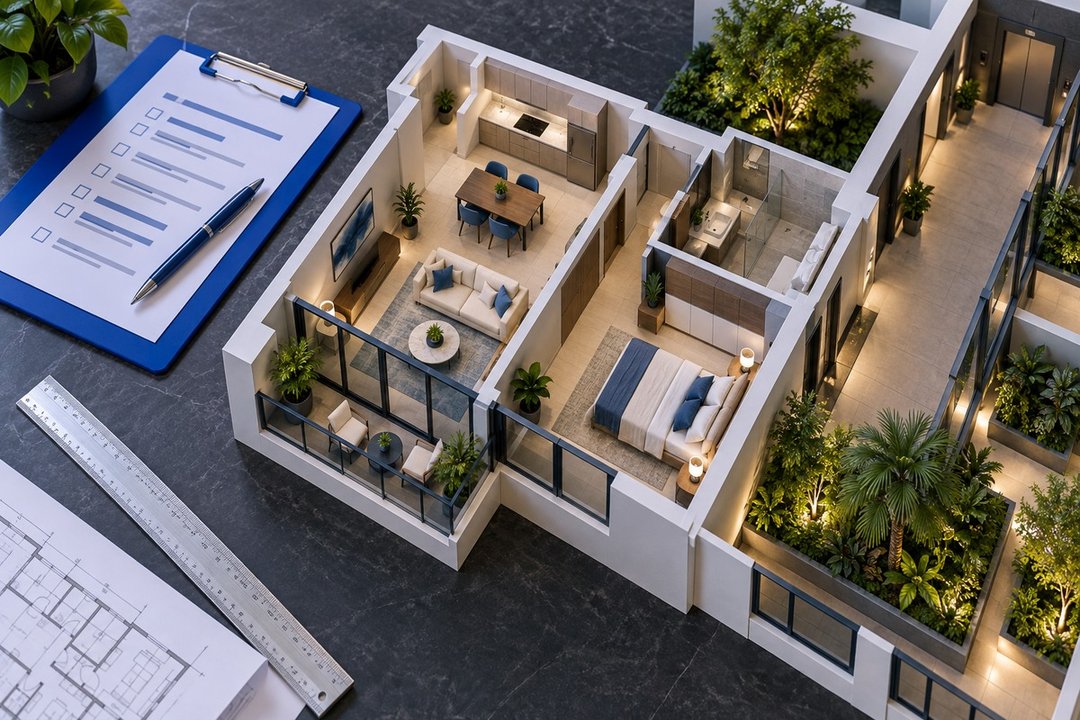
The cover is an original AI-generated conceptual illustration of an apartment model and inspection materials. It does not show an actual inspected property, a violation, a municipal document or a SIBRIS development.
Sources & further reading
 Illustration
UAE food caps: read the category, the units and the phase
MoHAP’s latest update covers selected packaged foods. A practical guide to reading the figures without confusing a serving with 100 grams or a final target with today’s limit.
2 min read
Read story Illustration
DEWA’s two-minute application: what the AI update means for moving home
DEWA reports fewer inputs and a faster electricity and water application. Here is how to read the timing claim when planning a move.
2 min read
Read story Illustration
Tessera in Dubai South: look beyond the floor area
Al Ghurair’s new residential launch puts privacy and townhouse-style layouts in focus. Here is how to read the design claims against the plan for an individual home.
2 min read
Read story